
Ep.78 / Civil Rights, DEI & The Myth of “Reverse Discrimination”
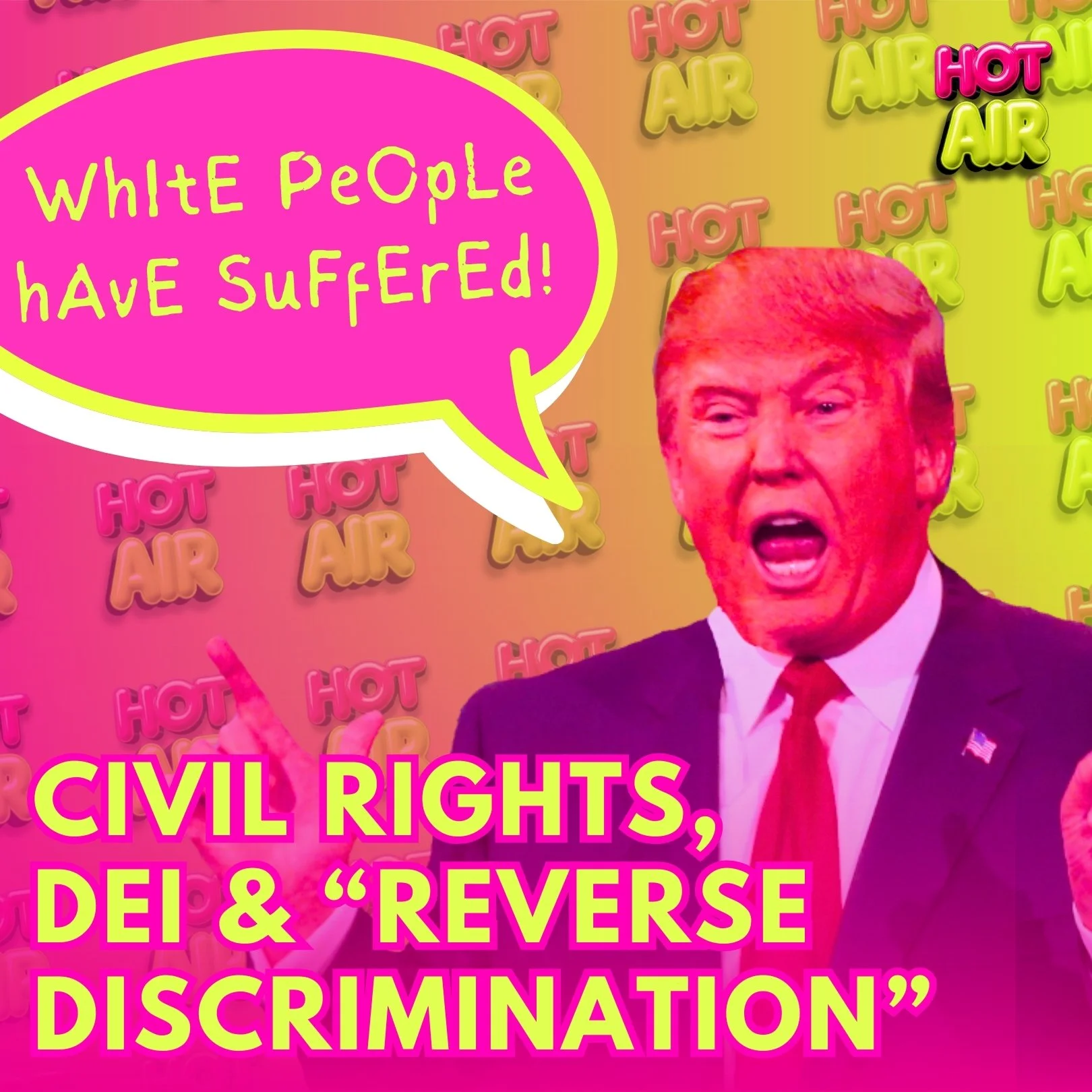
What the Civil Rights Act, DEI, and equality really mean. A smart, funny breakdown of civil rights history, women’s rights, LGBTQ+ rights, and “reverse discrimination.”
History Didn’t End in 1964: Civil Rights, DEI, and the Myth of “Reverse Discrimination”
Every few years, someone in politics dusts off the same tired claim: that civil rights laws discriminate against white people.
Recently, that claim came back into the spotlight when Donald Trump suggested the Civil Rights Act makes white Americans “look bad” or puts them at a disadvantage.
And every time I hear that argument, I have the same reaction: not anger — confusion.
Because that statement only works if you either don’t know American history… or you’re hoping nobody else does.
So let’s talk about it.
Not with vibes. Not with Twitter threads. With facts, timelines, and context.
Because when you actually look at what the Civil Rights Act, women’s rights laws, LGBTQ+ protections, and DEI policies were created to do, the idea of “reverse discrimination” falls apart fast.
What the Civil Rights Act Actually Did
The Civil Rights Act of 1964 didn’t give minorities special treatment.
It did something much simpler: it made discrimination illegal.
Before 1964, businesses could legally refuse to hire Black people. Restaurants could deny service. Hotels could turn guests away. Schools could segregate students. Employers could openly say, “We don’t hire women” or “We don’t hire people like you.”
And none of that broke the law.
The Civil Rights Act changed that.
Title VII banned discrimination in hiring based on race, sex, religion, or national origin. It didn’t force companies to hire unqualified candidates. It just stopped them from excluding qualified ones.
That’s not favoritism. That’s fairness.
As President Lyndon B. Johnson put it when signing the bill: “You do not take a person who has been hobbled by chains and liberate them… and still justly believe you have been completely fair.”
Equality isn’t about pretending history didn’t happen. It’s about responding to it.
Women’s Rights Are Shockingly Recent
If you think women’s equality has been around forever, here’s a quick reality check.
Women couldn’t vote until 1920.
They couldn’t open a bank account without a husband until 1974.
They couldn’t get credit cards without male co-signers in many places until the 1980s.
That’s not ancient history. That’s your mom’s lifetime.
Financial independence is how people build wealth. Buy homes. Start businesses. Invest. When women were locked out of that system for decades, that disadvantage compounded.
So when people say, “Women already have equality,” they’re ignoring how recent — and fragile — that equality really is.
How Redlining Created the Racial Wealth Gap
If you really want to understand why civil rights protections still matter, look at housing.
For decades, the federal government and banks used a practice called redlining, denying mortgages to Black families based purely on where they lived.
White families built wealth through homeownership. Black families were blocked.
And homeownership is the number one driver of generational wealth in America.
That means college tuition, emergency funds, inheritances, and business opportunities all flowed disproportionately to white families.
Those effects didn’t disappear when discrimination became illegal. They compounded.
That’s why the racial wealth gap still exists today.
Not because of effort. Not because of “culture.” Because of policy.
LGBTQ+ Rights Are Brand New
Marriage equality became legal nationwide in 2015.
Let that sink in.
Before that, same-sex couples had fewer legal protections than straight couples.
Employment protections for LGBTQ+ workers weren’t guaranteed until 2020.
Which means many adults today spent most of their lives legally vulnerable simply for being themselves.
So when someone asks, “Why do they still need rights?” the answer is simple: because they just got them.
What DEI Really Means
DEI — Diversity, Equity, and Inclusion — has become one of the most misunderstood phrases in politics.
It doesn’t mean hiring unqualified people.
It means creating hiring systems that reduce bias.
Because without guardrails, humans default to familiarity. We hire people who look like us, talk like us, and feel comfortable.
That’s not meritocracy. That’s comfort.
DEI asks companies to widen the lens. To make sure qualified candidates aren’t being filtered out by unconscious bias or old networks.
It’s not about punishing anyone.
It’s about fairness.
Why “Reverse Discrimination” Isn’t Real
Here’s the core truth: equality feels threatening when you’re used to advantage.
If you’ve always had a head start, the starting line suddenly moving back to zero can feel like something was taken away.
But nothing was taken.
Other people were simply allowed to join the race.
And that’s not discrimination.
That’s democracy.
The Bottom Line
History didn’t end in 1964.
Passing a law doesn’t erase centuries of exclusion overnight.
Civil rights laws, women’s rights protections, LGBTQ+ equality, and DEI policies weren’t created to punish anyone.
They were created to stop harm.
To open doors that were deliberately closed.
To make “equal opportunity” mean something real.
And if that makes some people uncomfortable?
Good.
Growth usually is.
If you want more smart, funny, fact-based conversations about culture, politics, and the world we actually live in, listen to the latest episode of HOT AIR with Joshua Robert — now streaming everywhere.