
Ep.121 / Absolutely Unhinged: Hate Crimes & AI Twinks
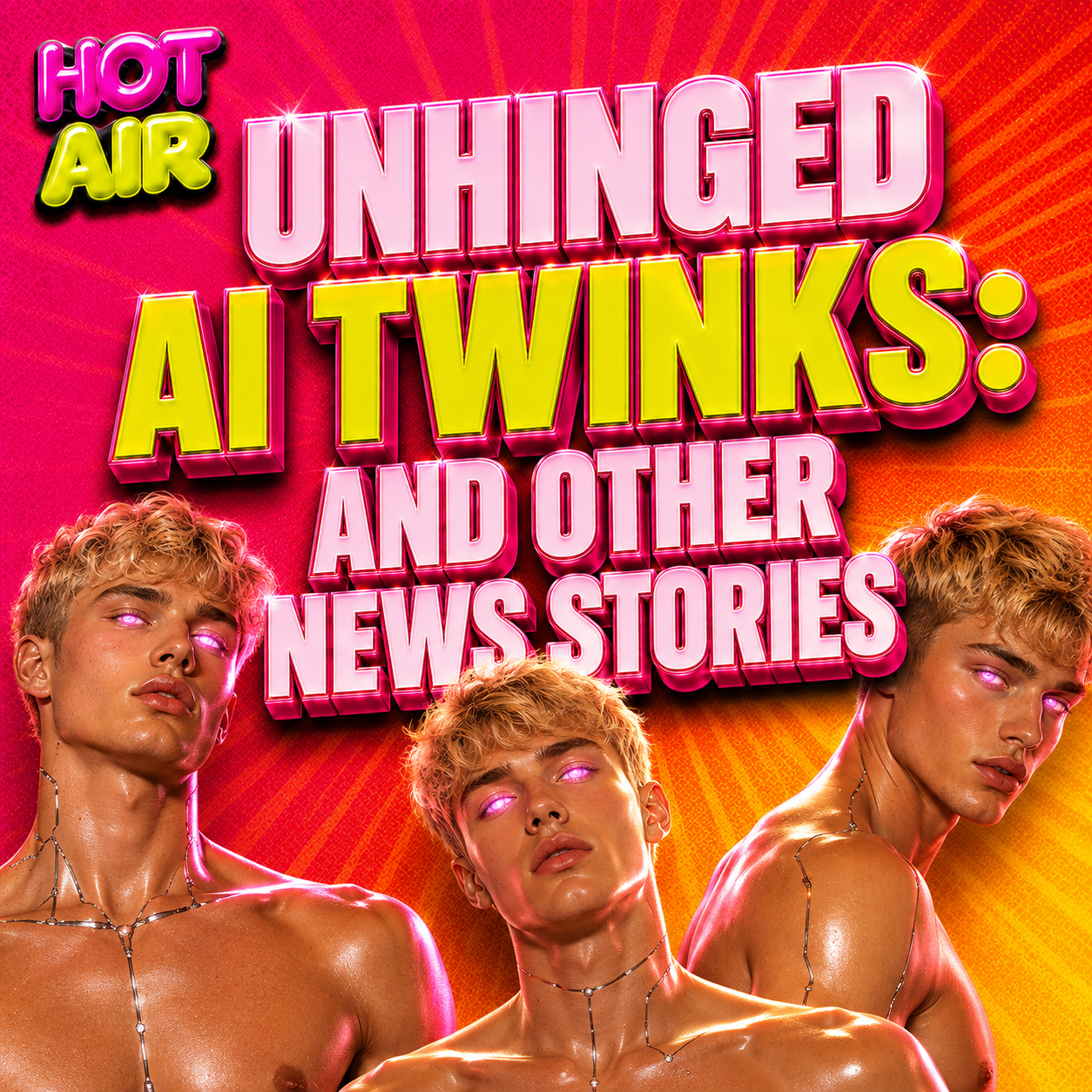
five major LGBTQ news stories: the deadly hate-motivated shooting outside Tucson gay bar Venture-N; Everton Blair making history as Georgia’s first openly gay congressman; Derek Chadwick leaving gay dating app Goose after controversy surrounding apparently AI-generated accounts; Trump-backed congressional candidate Marty O’Donnell’s comments about LGBTQ people, Pride and Western civilization; and new findings showing the real-world consequences of disruptions and cuts to PEPFAR HIV/AIDS programs.
The Gay News Cycle Is Absolutely Unhinged: Hate Crime, AI Twinks & LGBTQ History
There are weeks when LGBTQ news feels hopeful. There are weeks when it feels terrifying. And then there are weeks when apparently every possible gay storyline gets thrown into a blender at the same time.
This is one of those weeks.
We have a deadly hate crime outside a longtime gay bar. We have a young Black gay man making history in Congress. We have a gay dating app engulfed in questions about apparently AI-generated men recruiting actual gay men. We have a Trump-backed congressional candidate talking about LGBTQ people as part of an alliance he believes threatens Western civilization. And we have new evidence showing serious damage to one of the most successful HIV/AIDS programs in modern history.
Tragedy, progress, technology, politics and public health.
Basically, the full gay tasting menu.
But beyond the chaos of the individual headlines, these stories tell us something important about LGBTQ life in 2026: progress and backlash are happening at exactly the same time.
Tucson Gay Bar Shooting Confirmed as an Anti-LGBTQ Hate Crime
We have to begin with the heaviest story.
Police in Tucson, Arizona, have confirmed that the deadly shooting outside Venture-N, a longtime gay bar and gathering place for the city’s LGBTQ community, was motivated by anti-LGBTQ hate.
Vincent Anthony Siqueiros, 42, and Cameron Davis Capara, 33, were fatally shot in the parking lot. Police say the 44-year-old attacker later died after shooting himself. Investigators said the men did not know their killer, and a search of his home uncovered a note indicating the attack was motivated by hatred toward the LGBTQ community. Authorities also discovered information referencing other LGBTQ-associated businesses, though police said the attacker acted alone and there was no known ongoing threat.
That distinction matters.
These were not two gay men who happened to die during an unrelated dispute. According to police, their connection to an LGBTQ space was central to why they were targeted.
Gay bars have always carried a meaning beyond alcohol and dancing. For generations, queer bars were among the few public places LGBTQ people could gather openly, meet partners, find friends and build community.
They are bars, yes.
They are also history.
That is why violence targeting one of those spaces hits differently. The message is not simply aimed at the individual victims. It reaches everyone who has ever walked through that door and felt safer once they were inside.
And that makes the next story feel almost surreal by comparison.
Everton Blair Makes LGBTQ History in Georgia
While one community is mourning an attack against queer people, Georgia just reached a milestone that would have seemed nearly impossible during much of the country’s history.
Everton Blair Jr. has become Georgia’s first openly gay congressman.
Blair, 34, won an August special election for Georgia’s 13th Congressional District and became only the third Black gay man elected to the U.S. House. He is also the first openly gay Black congressman from the South.
That sentence deserves a moment.
An openly gay Black man from Georgia is now sitting in the United States Congress.
Blair previously worked as a public-school teacher and served on the Gwinnett County Board of Education. His congressional tenure will be unusually brief—he is completing the remainder of the late Rep. David Scott’s term and will serve only several months—but history does not become less historic because the calendar is short.
Representation alone does not solve discrimination. A queer person winning office does not magically erase anti-LGBTQ legislation or make every queer kid in the South safe.
But visibility changes what people believe is possible.
A kid growing up gay in Georgia can now look at the congressional delegation from their own state and see someone who shares that part of their identity.
That did not exist before.
Now it does.
Derek Chadwick Leaves Goose After AI Dating-App Controversy
And because this is gay news and apparently emotional consistency is prohibited, we now need to leave Congress and discuss AI twinks.
Model, actor and entrepreneur Derek Chadwick announced in August that he had stepped away from Goose, the gay dating and social app he helped launch only weeks earlier.
Goose had positioned itself as a more social, community-focused alternative to traditional gay dating apps—something focused on friendship, dating and connection rather than exclusively hookups.
Then things became strange.
A WIRED investigation examined social-media accounts that had been promoting Goose and messaging gay men with invitations to join the platform. Many of those accounts showed signs of being artificial or inauthentic, with some profile images appearing likely to have been AI-generated. Reporting also found an account connected to Goose cofounder David Aliagas advertising social-media work involving “finstas,” or fake Instagram accounts.
Important distinction: that does not establish that Chadwick personally created fake accounts, nor has Chadwick said the AI controversy is why he left Goose.
In announcing his departure, he said his vision for where Goose should go and the direction the company was taking were no longer aligned, adding that he wanted to be able to fully stand behind anything carrying his name and face.
Still, the broader question is fascinating—and a little terrifying.
Online dating already requires an absurd amount of trust. Now artificial intelligence can generate a completely convincing hot man who never existed.
Apparently being catfished with stolen pictures was too straightforward.
We have innovated.
Marty O’Donnell, Pride and the Supposed Threat to Western Civilization
Then there is Marty O’Donnell, the composer famous for his work on Halo and Destiny who is now the Trump-endorsed Republican nominee challenging Democratic Rep. Susie Lee in Nevada.
His comments generated headlines claiming he called LGBTQ people an “existential threat” to Western civilization, but the full context is worth explaining accurately.
O’Donnell specifically identified Marxism and anti-Western philosophy as the “abyss” or existential threat he believes America faces. He then described LGBTQ people, Islamists and Marxists as groups pretending to be oppressed and claimed they were temporarily allied in an effort to “overthrow the West.”
So the precise claim is not simply, “Gay people alone are the existential threat.”
The actual statement is still extraordinary enough without exaggerating it.
During the same interview, O’Donnell described Pride as one of the seven deadly sins and said he was “all for bringing back shame.” His broader record also includes criticism of same-sex marriage, transgender identities and LGBTQ inclusion.
And this is where political disagreement turns into something larger.
A candidate can oppose a policy. A candidate can disagree with a political movement. But when millions of Americans are described as people pretending to be oppressed while participating in an alliance aimed at overthrowing civilization, we are no longer simply debating a tax rate.
These are people that candidate would represent if elected.
Apparently gay people are simultaneously a tiny minority and powerful enough to bring down the entire West.
We really need to pick a lane.
HIV/AIDS Funding Cuts Are Already Having Consequences
The final story may get less attention online than political outrage, but its consequences could be far more significant.
PEPFAR—the President’s Emergency Plan for AIDS Relief—was launched in 2003 under President George W. Bush and became one of the largest global HIV/AIDS initiatives ever created. It is credited with saving more than 26 million lives.
New research from amfAR and partner organizations paints an alarming picture following funding freezes, payment delays, grant terminations and broader disruptions to U.S. foreign assistance.
A survey of 166 PEPFAR-funded organizations across 46 countries found that 1,714 HIV service-delivery sites closed. HIV prevention spending fell 51 percent between fiscal years 2024 and 2025. More than one quarter of surveyed implementing partners permanently stopped providing PrEP, while 73 percent of organizations providing services specifically to key populations ended at least one service.
A separate analysis of PEPFAR program data found HIV testing dropped by 14 million tests, PrEP initiations fell 33 percent and the HIV workforce declined by more than 60,000 workers.
The administration has argued that lifesaving treatment continues and that its approach is shifting toward new agreements requiring recipient countries to take greater responsibility for health programs. Critics argue that maintaining medication alone cannot replace the testing, outreach, prevention and community infrastructure necessary to keep an epidemic under control. PBS reported both sides of that debate while documenting the scale of the disruption described by amfAR.
And this is especially relevant to LGBTQ communities because gay and bisexual men, transgender people and other populations disproportionately affected by HIV rely heavily on prevention, testing and outreach services.
We already know how to prevent many HIV infections.
We already know how to treat HIV.
We have the medicine.
The question is whether people can actually reach it.
LGBTQ Progress and Backlash Are Happening Together
Taken individually, these stories seem completely unrelated.
A shooting in Arizona. An election in Georgia. A dating app. A congressional race in Nevada. HIV clinics around the world.
But put them together and they create a surprisingly accurate snapshot of LGBTQ life right now.
Queer people have more visibility and political representation than generations before us could have imagined.
At the same time, anti-LGBTQ rhetoric remains politically useful.
Technology is creating new opportunities for queer connection while simultaneously making it harder to know whether the person connecting with you actually exists.
Science has given us extraordinary tools to fight HIV while political decisions threaten the infrastructure necessary to deliver those tools.
And safe spaces can be both stronger and more visible than ever while still becoming targets of violence.
Progress is not a straight line.
It can look like Everton Blair walking into Congress while Tucson’s LGBTQ community is lighting candles outside a gay bar.
Both realities exist at once.
That is exactly why paying attention matters.
Not because queer people need to spend every waking minute doom-scrolling through political news. We absolutely do not. Sometimes protecting your peace means closing the app, ordering dinner and watching something incredibly stupid.
But being informed gives us the ability to distinguish real threats from outrage bait, celebrate progress when it happens, demand accountability when it is needed and recognize when a headline requires more context than a 15-second TikTok can provide.
The gay news cycle may indeed be absolutely unhinged.
But underneath the chaos are real people, real policy and real consequences.
And occasionally, thankfully, a little bit of history being made.