
Ep.120 / Where F*ck Did My Motivation Go? Why You’re Not lazy
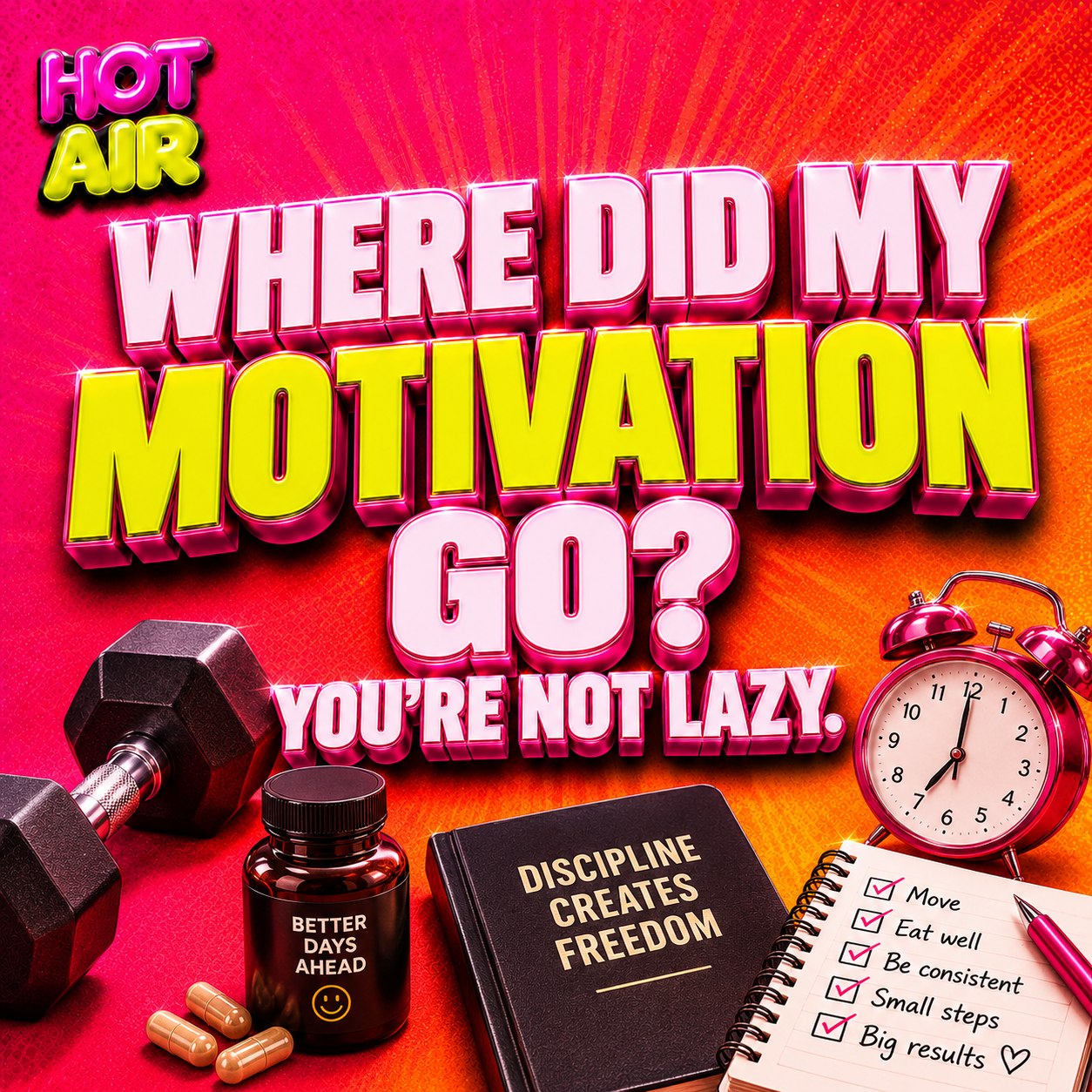
You can work out consistently for a year, read every night, take your vitamins, meal prep, sleep on schedule and feel completely locked in…until suddenly you don’t. One habit slips, another follows, and before long you’re looking at the version of yourself who used to have everything together wondering what happened.
Where the Fuck Did My Motivation Go? Why You’re Not Lazy
There is a very particular kind of panic that happens when you used to be incredibly consistent and suddenly you are not. Maybe you worked out five days a week for an entire year. You meal prepped. You took your vitamins. You went to bed at a reasonable hour. You read before bed instead of lying there watching TikToks until your phone fell directly onto your face. You were one of those deeply irritating people who seemed to have their shit together. And then, somewhere along the way, one habit slipped. Then another one did. The workouts became less frequent. Your sleep got weird. The book sat untouched on the nightstand. The vitamins somehow became an impossible administrative task despite requiring approximately four seconds of effort. Eventually you looked around and thought: Where the fuck did my motivation go?
That question has been especially familiar to me throughout 2026. My own workout routine has been inconsistent compared with what I’m used to. My eating habits have been different. I’ve been bad about taking vitamins. I haven’t been reading every night the way I normally do, and my sleep schedule has not exactly been submitting an application for wellness influencer of the year. What made all of this harder was knowing exactly how disciplined I had been before. I had evidence of another version of myself who could apparently do all of these things. So instead of simply noticing that my routines had changed, my brain started treating the change like a personality problem. I wasn’t just exercising less. Apparently I had “lost my discipline.” I wasn’t just reading less. Apparently I had “fallen off.” One period of inconsistency became evidence in a completely imaginary trial about whether I still had my shit together.
And that is where we misunderstand motivation.
Motivation Isn’t a Personality Trait
We love describing people as “motivated” or “unmotivated,” as though motivation is something installed at birth like eye color. The disciplined people received the premium package and everyone else got the free trial.
Real motivation is much more responsive than that. It changes depending on what we’re doing, why we’re doing it, how rewarding it feels, how stressed we are, whether we feel capable, what else is demanding our attention and whether the activity still fits our lives.
One well-known framework called self-determination theory looks at motivation partly through three basic experiences: autonomy, competence and relatedness. In normal-person language: Do I feel like I have some choice? Do I feel capable of getting better? Do I feel connected to something or somebody that makes this meaningful? Those conditions can affect how engaged and persistent people feel.
That already gives us a much more useful explanation than “I’m lazy.”
Think about starting a new workout program. Everything is exciting. New exercises. New goals. New progress. Maybe new gym clothes, which scientifically improve every workout by approximately 37%. Your weights start going up. Your body changes. You feel successful every time you complete another week.
Six months later?
Tuesday is legs.
Again.
The workout can still matter deeply to you without producing the same emotional fireworks.
That is not failure. Something exciting eventually becoming ordinary is often exactly what happens when it becomes part of your life.
Why One Missed Day Can Become Three Months
The bigger problem usually arrives after motivation dips.
You miss Wednesday’s workout.
A perfectly reasonable response would be: “I missed Wednesday.”
But many of us instead respond with: “Well, apparently everything is fucked.”
Now Thursday somehow no longer counts because the week is already “ruined.” So we’ll restart Monday. Except Monday gets busy. Fine, next Monday. Actually, the first of the month would feel cleaner. Perhaps January.
This is where all-or-nothing thinking absolutely destroys consistency.
If the only acceptable version of your routine is perfect execution, every normal interruption becomes evidence of failure. Four workouts instead of five somehow feels worse than doing none because the plan says five. Reading three evenings instead of seven becomes “I stopped reading.”
And once failure becomes the story, shame usually joins the meeting.
“You used to be so disciplined.”
“What happened to you?”
“You were doing so well.”
We tell ourselves this is accountability. If we stop being hard on ourselves, surely we’ll become complacent and spend the remainder of our lives horizontally scrolling Instagram while eating cereal directly from the box.
Research does not necessarily support that fear. In experiments by researchers Juliana Breines and Serena Chen, people encouraged to respond to personal failures or weaknesses with self-compassion showed greater motivation toward improvement in several situations. Self-compassion did not automatically make people stop caring. It could make it easier to re-engage.
That distinction matters.
Self-compassion is not:
“Well, fuck it. Nothing matters.”
It’s:
“Okay. This happened. What would actually help now?”
Maybe You Don’t Need Your Old Routine Back
This may be the part we resist most.
Sometimes the routine that worked before does not fit anymore.
Your schedule changed. Your job changed. Your relationship changed. Your stress changed. Maybe mornings were once completely yours and now they aren’t. Maybe you had enough energy for six workouts every week during one chapter of life and four makes more sense now.
We often respond by desperately trying to resurrect Old Us.
Old Josh exercised this way.
Old Josh read every night.
Old Josh went to bed at this time.
Fine.
Old Josh also had a different life.
There are absolutely habits from previous routines that I want back. But that does not mean I have to reconstruct every detail of some earlier version of myself.
A more useful question is:
What does taking care of myself look like in my actual life now?
That question leaves room for adaptation without turning adaptation into surrender.
Maybe your goal is still being physically active, but instead of six 90-minute sessions, it becomes four workouts and yoga.
Maybe reading every night becomes reading three nights a week.
Maybe a complicated nighttime routine gets reduced to the three things that genuinely help you.
Healthy habits are supposed to support your life.
Your life is not supposed to become a full-time job dedicated to maintaining healthy habits.
Build Habits That Work When Motivation Doesn’t
The real test of a routine is not how beautifully it works during your most motivated month.
It is whether it can survive the shitty ones.
That is where smaller versions of habits become incredibly useful.
If the ideal workout is 90 minutes, what is the version you can do when you have almost nothing in the tank?
Twenty minutes?
Great.
If the ideal creative session is three hours, could you work for fifteen minutes rather than disappearing from the project entirely?
If reading a chapter feels impossible, read two pages.
Small does not mean meaningless.
Sometimes the goal during a low-motivation period is simply maintaining your connection with the behavior.
Specific plans can help too. Instead of “I should exercise more,” decide: “If it is Tuesday after work, I go to the gym.” These kinds of if-then plans, often called implementation intentions, have been studied as a way of helping people translate goals into behavior.
You are basically making the decision before tired future-you gets involved.
Because tired future-you has opinions.
Stop Measuring Your Entire Life by Tuesday
Another thing that helps enormously is changing the time frame.
One missed workout looks catastrophic if the measurement period is today.
Across a year?
Nobody cares.
Imagine exercising 150 times this year and then deciding the entire thing was a failure because you skipped three Wednesdays.
That is absurd.
Yet emotionally, we do versions of it constantly.
A bad week can exist inside a good year.
A difficult few months can exist inside a decade of taking care of yourself.
A creative dry spell does not cancel your creativity.
Three months away from the gym does not erase everything your body learned beforehand.
“Back to square one” is one of the most dramatic phrases we use about habits.
Square one was before you knew anything.
You are not there anymore.
Consistency Is Returning
Maybe consistency needs a better definition.
We tend to imagine that a consistent person never stops.
They exercise forever.
They read forever.
They write forever.
They wake up at 5:30 every morning until they die peacefully at age 103 while holding a green smoothie.
Real consistency is much messier.
People stop.
They get bored.
They travel.
They fall in love.
Their job becomes insane.
They get stressed.
They change goals.
They sleep badly.
They lose momentum.
Then, eventually, they return.
That return may be the most important skill of all.
Instead of creating a perfection rule—I never miss—create a return rule:
Missing is allowed. Returning is expected.
You do not need a dramatic comeback.
No new personality.
No 5 a.m. alarm.
No thirty-day punishment plan.
No announcement that the old you is officially dead and this is your new era.
Go for a walk.
Take the vitamin.
Read two pages.
Do the twenty-minute workout.
Open the project.
Then do something again tomorrow.
You Probably Didn’t Lose Yourself
If your motivation has disappeared lately, it does not automatically mean something is wrong with you.
Maybe your circumstances changed.
Maybe the novelty wore off.
Maybe the routine became too demanding.
Maybe you are stressed.
Maybe something that once mattered enormously matters slightly less now.
Or maybe you still care just as much and simply need a different system for expressing it.
The most useful question may not be:
“How do I force myself to become the old me again?”
It might be:
“What does the current version of me actually need?”
You can want more for yourself without hating yourself for where you are.
You can recognize that your habits have slipped without turning that observation into a verdict about your character.
You can make changes without making those changes punishment.
And you can spend a few months completely off your game without losing every bit of progress that came before.
Motivation will leave.
It will come back.
Then it will probably leave again.
That is not the flaw in the system.
That is the system.
So build a life that can survive it.
Because consistency was never about never falling off.
Consistency is learning how to come back.