
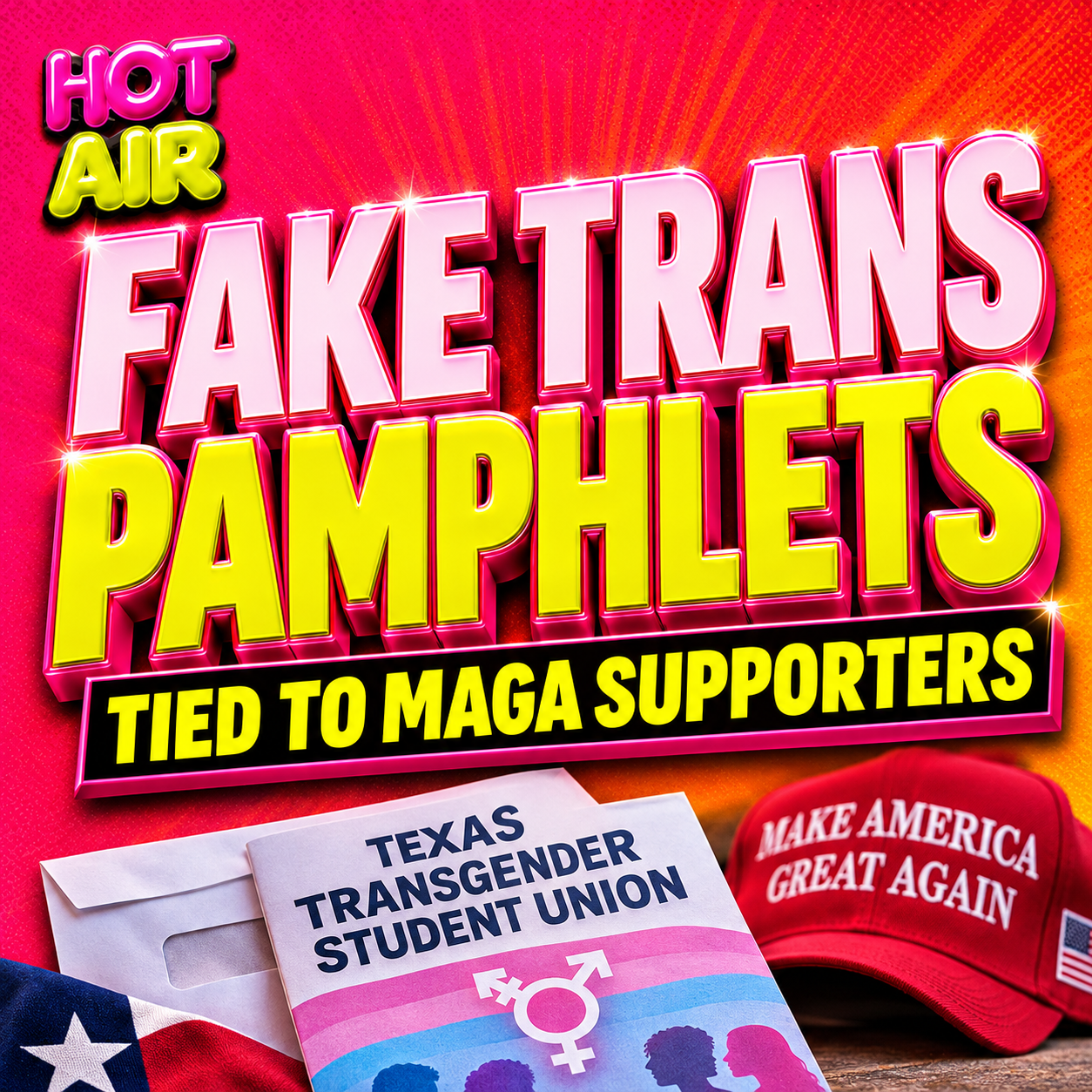
Someone mailed deceptive transgender student pamphlets to homes across Texas just as early voting began. Nobody publicly knows who was behind them—but the backlash against real transgender people was immediate.
They Mailed Fake Trans Pamphlets to Texas Families. Then the Hate Started.
Imagine opening your mailbox and finding a glossy pamphlet addressed not to you, but to the “student” in your household.
The pamphlet claims to be from something called the Texas Transgender Student Union. It tells LGBTQ students where they can find supportive adults, talks about what happens when parents do not support a child’s gender identity, includes information about emancipation and sends readers toward transgender advocacy resources.
Then imagine photographs of that pamphlet exploding across social media right as Texans begin voting in a major midterm election.
People get angry.
Politicians post about it.
Comment sections fill with accusations that transgender activists are trying to reach children behind their parents’ backs.
Some people talk about burning the pamphlets.
There is only one problem.
The transgender advocacy organization whose resources appeared throughout the pamphlet says it had absolutely nothing to do with sending it.
And nobody publicly knows who did.
What Were the Texas Transgender Mailers?
The pamphlets began appearing across Texas in October 2026, around the opening days of early voting for the November 3 midterm election.
They were branded as resources from the Texas Transgender Student Union and addressed to the “student” of households. According to reporting from The Texas Tribune and CBS Texas, the materials discussed gender identity, unsupportive parents, “safe adults,” advocacy groups and emancipation. The Texas Tribune
When journalists started investigating the sender, things became strange very quickly.
Business records showed that a company named Texas Transgender Student Union LLC had been formed in Wyoming on September 2—only weeks before the mail campaign began.
Wyoming allows LLC ownership information to remain largely private in public filings, meaning the records do not identify the people controlling the company. The organization also appeared to have virtually no established public history as a transgender advocacy group. CBS News
Meanwhile, much of the resource information inside the pamphlet pointed recipients toward the Transgender Education Network of Texas, better known as TENT.
TENT says it did not write, approve or distribute the mailers.
Its attorneys say the materials copied the look and feel of legitimate resources while adding information the organization does not endorse, including content about emancipation. TENT says the association triggered severe backlash and threats against the organization and transgender Texans. The Texas Tribune
Was the Republican Party Behind the Mailers?
This is where accuracy matters.
There has been widespread speculation that the mailers were intended to provoke conservative voters and push them toward Republican candidates.
A Republican district attorney investigating the pamphlets said she believed they appeared to be an obvious attempt to anger voters ahead of the midterms. Political observers have made similar assessments. The Texas Tribune
But that is not the same as proving who funded them.
The campaigns of Republican Ken Paxton and Democrat James Talarico both denied involvement. The National Republican Congressional Committee also denied involvement. As of November 2, the people who funded and directed the mail campaign have not been publicly identified. The Texas Tribune
TENT went to court seeking information that could uncover the sender. A Travis County judge initially ordered representatives connected to the Texas Transgender Student Union to answer questions under oath.
On October 30, the Texas Supreme Court temporarily blocked that deposition just minutes before it was scheduled to occur. The Texas Tribune
There is also a separate investigation involving text messages directing Texans to TENT resources. A deposition in that case named the Republican Women’s Caucus Fund, but the organization has categorically denied authorizing, funding or participating in those texts. That development should not be treated as proof of who sent the physical mailers. The Texas Tribune
In other words: there are legitimate reasons to investigate political motives.
There is not yet legitimate evidence to simply declare the case solved.
The Pamphlets Were Misleading. The Hate Was Real.
That may be the most important part of this story.
Even if investigators eventually prove that the entire campaign was designed as political bait, the reaction it generated cannot be erased.
TENT says it received threats.
Transgender people watched strangers describe people like them as predators and threats to children.
Social media users celebrated destroying or burning material they believed was designed to support trans youth.
The pamphlet may have been deceptive.
The response was not imaginary.
And that tells us something uncomfortable about how effective transgender people have become as political symbols.
You do not necessarily need to show voters something that actually happened.
You need to show them something that activates an existing fear.
Put “transgender” next to “children.”
Add schools.
Add parents.
Add medical care.
Then let social media do the rest.
By the time a fact-check appears, people have already felt the emotion the message was designed to create.
Fear moves extremely fast.
Corrections usually do not.
Can a Child Go to School and Come Home Medically Transitioned?
No.
This idea has become so common in political rhetoric that it is worth explaining exactly how absurd it is.
First, transition does not automatically mean medical treatment.
A young person might socially transition by changing their name, clothing, hairstyle or pronouns. The American Academy of Pediatrics describes those changes as social affirmation and distinguishes them from medical treatment. American Academy of Pediatrics
No medication is involved.
No surgery is involved.
No teacher is prescribing anything.
For prepubertal children, the Endocrine Society specifically recommends against puberty blockers and gender-affirming hormones. Gender-related hormone therapy is not used before puberty because puberty-related sex hormones have not yet begun producing those changes. Endocrine Society
That alone destroys the idea that a young elementary-school child can suddenly be placed on transition hormones because they expressed discomfort about their gender.
What Happens When Puberty Begins?
Puberty blockers are a separate medical intervention.
Under Endocrine Society guidance, they are considered only after puberty has actually begun. An experienced clinician should confirm the physical onset of puberty, and gender dysphoria or gender incongruence should be evaluated by a qualified professional. Endocrine Society
For adolescents considering gender-affirming hormones such as testosterone or estrogen, the process becomes more involved.
The Endocrine Society recommends care by an experienced multidisciplinary team. Before hormones are initiated, clinicians should confirm the persistence of gender incongruence, assess the young person’s ability to understand treatment and discuss issues including fertility preservation. Ongoing monitoring and laboratory testing are also part of treatment. Endocrine Society
That does not mean every transgender teenager follows one universal timeline.
Healthcare systems differ.
State laws differ.
Individual patients differ.
And medical organizations continue debating and refining how adolescent gender care should be delivered.
But there is no credible medical pathway where a teacher diagnoses a student during lunch and sends them home on hormones that afternoon.
Do Transgender People Have to Spend Years in Therapy?
Not necessarily—and this is an important misconception on both sides of the debate.
People sometimes respond to anti-trans misinformation by claiming every transgender person must complete years of mandatory psychotherapy before receiving any medical care.
That is not universally true either.
Modern standards are increasingly individualized. WPATH states that there is no one-size-fits-all path to transition, and people may pursue all, some or none of the available medical interventions. Earlier WPATH standards explicitly stated that psychotherapy itself is not an absolute requirement for hormones or surgery, although assessment and mental-health support can play important roles. WPATH
For adults, many clinics use informed-consent approaches to hormone therapy.
Patients still receive medical assessment, risk counseling, fertility discussions and follow-up monitoring.
That is very different from saying someone simply walks into a pharmacy and asks for estrogen like they are buying Advil.
What About Gender-Affirming Surgery?
Surgery is another category entirely.
The phrase “sex change” makes it sound like there is one standardized procedure.
There is not.
Gender-affirming surgery can include chest procedures, hysterectomy, orchiectomy, genital reconstruction, facial procedures and other surgeries.
These interventions involve surgeons, medical clearance, informed consent, consultation, anesthesia, recovery and follow-up.
The American Academy of Pediatrics describes gender-affirming surgery as typically an adult intervention, although some procedures have historically been considered for adolescents on a case-by-case basis. The Endocrine Society recommends delaying genital surgeries involving removal of reproductive organs until at least age 18 or the legal age of majority. Endocrine Society
And in Texas, the political panic becomes even stranger because state law already restricts transition-related puberty blockers, hormones and surgeries for minors.
So the image of Texas schoolchildren secretly undergoing medical transition at school is not simply exaggerated.
It is detached from how both medicine and Texas law actually work.
The Real Lesson From the Fake Pamphlets
There is a temptation to look at this entire story and say:
“Well, the mailers were fake. Problem solved.”
But that misses what happened.
The pamphlets may have misrepresented who created them.
The anger they triggered was real.
The threats were real.
The misinformation circulating about transgender healthcare is real.
And transgender children and adults still have to live in the environment created by all of it.
That is why allyship matters even when a viral story turns out to be deceptive.
A transgender teenager scrolling through social media still sees the comments.
They still see adults celebrating the destruction of something believed to be designed for kids like them.
They still hear politicians describe their existence as something parents should fear.
No correction two days later completely takes that back.
Ask Questions Before You Get Angry
The Texas transgender mailer story offers a surprisingly useful lesson in how to consume political information in 2026.
Before sharing something designed to make you furious, ask:
Who created it?
Is the organization real?
Has that organization acknowledged the material?
What are reputable reporters saying?
Does the headline match the evidence?
Is someone showing me an actual policy—or merely something that confirms what they already want me to fear?
Google has made “people-first content” an explicit part of its guidance for publishers.
Maybe we could use a little people-first thinking in politics too. Google for Developers
Because transgender people are not campaign props.
They are not symbols.
They are not a scary hypothetical used to increase voter turnout.
They are people.
And whoever created these pamphlets may have manufactured the organization, the branding and the controversy.
But they did not manufacture the hatred that followed.
That part was already there.
And that may be the most important story of all.